
To threaten China and Pakistan, and then to sharply cut back on military funding, bespeaks a remarkable trust in Beijing and Islamabad that is not borne out by anything they say or do, notes Ajai Shukla.

The laser-guided anti-tank guided missile is likely to significantly enhance the fire-power capability of the Indian Army particularly along the frontiers with Pakistan and China, the officials said.
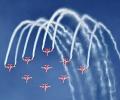
'At Aero India 2025, be prepared to be inspired, awed, and educated,' says Air Commodore Rohith Vijayadev, Air Officer Commanding Yelahanka. 'Aero India 2025 promises to be more than just an air show; it is a celebration of innovation, collaboration, and India's growing leadership in global defence and aviation,' notes Air Commodore Nitin Sathe (retd).

Two days after its successful trial, India on Saturday again test-fired the indigenously developed surface-to-air Akash missile from the test range at Chandipur near Balasore. "The user specific trial, which formed part of the country's routine air defence exercises, was conducted from the ITR," said a Defence Research Development Organisation official associated with the Akash missile project.

The Pinaka rockets have a range of around 37 km.
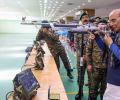
To make Bharat a developed and self-reliant country by 2047, the role of the Army is very crucial, said the defence minister.
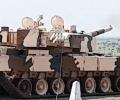
On Tuesday, June 28, 2022, the Defence Research and Development Organisation and the Indian Army successfully test-fired the Made In India developed laser-guided Anti-Tank Guided Missile from the Main Battle Tank Arjun at the KK ranges in Maharashtra's Ahmednagar district.

The Defence Research and Development Organisation successfully tested a new version of the Akash Missile --Akash Prime' -- from the Integrated Test Range in Chandipur, Odisha.
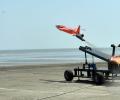
Developed by the Defence Research and Development Organisation, the High-speed Expendable Aerial Target (HEAT), ABHYAS, successfully flighttested from the Integrated Test Range in Chandipur, Odisha, October 22, 2021.

The missile test was carried out from a mobile launcher from launch complex-3 of the Integrated Test Range at about 10 am, defence officials said.

The new variant of the Akash missile (Akash-NG) can strike targets at a distance of around 60 km and fly at a speed of up to Mach 2.5.

By the time the enemy aircraft is 50 km away, the Akash-NG's computers have calculated the launch trajectory and impact point and launched the missile.
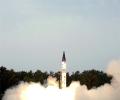
India on Friday successfully test-fired its indigenously developed nuclear-capable Agni-I ballistic missile with a strike range of 700 km from a test range off Odisha coast as part of a user trial by the army.

Describing the mission as a "major milestone" in the development of BrahMos, the sources said that the air version of the missile was test-fired from supersonic fighter aircraft Sukhoi 30 MK-I at 10.30 am.

The test was carried out by DRDO against a high-speed unmanned aerial target which was successfully intercepted by the missile.

The Defence Research and Development Organisation has said that the extended range version of the Brahmos missile of 450 km is likely to be tested on March 10.
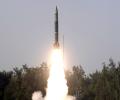
At present, the Pralay ballistic missiles can take out targets from 150 to 500 km and are extremely difficult to intercept for the enemy through interceptor missiles.

Investors should avoid making drastic changes to their asset allocation during a market correction.

Even as Chinese troops continue squatting on territory that we claim as our own -- this was the lowest allocation for defence in percentage terms since the 1950s, reveals Ajai Shukla.
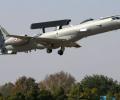
The AEWS&CS was developed by the Centre for Airborne Systems, a laboratory under the Defence Research and Development Organisation headed by woman scientist J Manjula.

India successfully test-fired its indigenously built nuclear capable Agni-I missile, which has a strike range of 700 kilometre on Thursday, from a test range off Odisha coast as part of a user trial by the army.
The missile was launched from a mobile launcher at the Integrated Test Range at the Wheelers' Island, a defence base in the Bay of Bengal on Orissa coast near in Balasore, Orissa, at 1015 hours. This was the second user trial of the precision target hitting missile to test its 'operational readiness', the scientists said. The last trial was conducted on October 5, 2007, from the same launch site.

It said the ATGM has been developed with a capability to launch from multiple platforms and is currently undergoing technical evaluation trials from 120 mm rifled gun of MBT Arjun.
A mock air defence exercise relating to India's indigenously developed interceptor missile is carried out from Wheeler's island off the Orissa coast today.

The QRSAM system is unique in its ability to operate on the move, searching for and tracking enemy targets; and then fire on a short halt.
The indigenously developed pilot-less target aircraft was test-fired from the Chandipur Intermediate Test Range.
"Agni-1, surface-to-surface single stage missile with 700 km range, will be taken up for test on Sunday," sources said, adding that Defence Research Development Organisation and operational strategic units of army and naval forces would jointly conduct the operation.

It said clinical trials of the drug 2-deoxy-D-glucose (2-DG) showed that it helps in faster recovery of hospitalised patients and reduces supplemental oxygen dependence.

The vehicle can be used as an aerial target for evaluation of various missile systems.

India on Friday night successfully conducted maiden night test of its indigenously developed nuclear-capable Agni-I ballistic missile with strike range of 700 km from a test range off Odisha coast as part of a user trial by the Army.

Naval assets take years to build, and therefore, not only is futuristic force planning essential, but indigenous projects must also be put into the pipeline, technologies developed and contracts for assets signed regularly so that the Indian Navy always remains a future-focussed force, asserts Vice Admiral Biswajit Dasgupta (retd).

The HSTDV is capable of powering missiles to attain a speed of around Mach 6 or six times the speed of sound, the officials said, adding only a very few countries like the United States, Russia and China have such a capability.

Describing the trial a "complete success", sources said that all the mission objectives were met during the test.

The state-of-the-art advanced missile, a product of joint venture between India and Israel.

ISRO's Thiruvananthapuram-based Vikram Sarabhai Space Centre successfully conducted a series of drogue parachute deployment tests at the rail track rocket sled facility of the Terminal Ballistics Research Laboratory in Chandigarh during August 8-10.

The Defence Research and Development Organisation and the Indian Air Force have jointly conducted two flight tests of an indigenously developed smart anti-airfield weapon in Rajasthan's Jaisalmer, the defence ministry said on Wednesday.
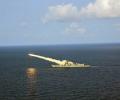
The new BrahMos missiles will be 'dual-role capable', which means warships can fire them at targets on land as well as at enemy warships.

In a post on X, Modi said, "Happy to have welcomed @POTUS @JoeBiden to 7, Lok Kalyan Marg. Our meeting was very productive."

The Indian Army has initiated this proposal worth around Rs 1,000 cror Swathi WLRs and it is planned to be put for consideration by a high-level defence ministry meeting.
 © 2026 Rediff.com - Advertise with us - Disclaimer - Privacy Policy - Sitemap - Feedback - About us - Terms of use - Grievances